Evaluating Clinical AI? Five Questions to Ask Before You Deploy
By AIdMD Team
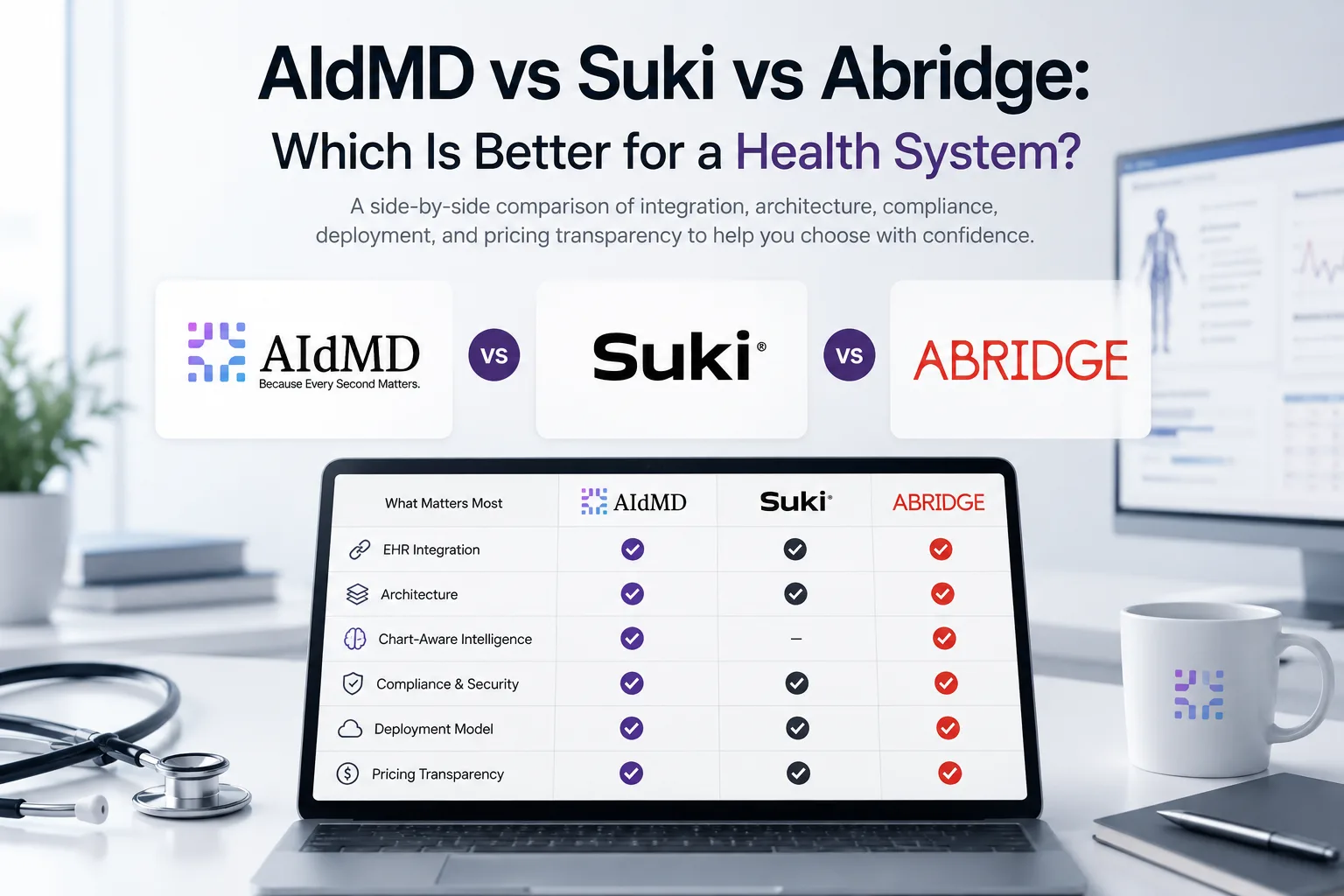
The market for clinical AI has moved fast: what was a novelty two years ago is now a line item in most medical groups' budgets. With dozens of vendors making similar promises, the difference between a successful deployment and an abandoned pilot usually comes down to questions asked before the contract is signed. Here are the five we believe matter most.
1. How is patient data protected — and is a BAA standard?
Any vendor touching protected health information should offer a Business Associate Agreement as a matter of course, and should be specific about safeguards: encryption in transit and at rest, role-based access controls, and audit logging. Ask the question directly: is patient data ever used to train public AI models? The acceptable answer is no.
2. Where does the AI get its context?
A scribe that hears only the conversation can document the conversation — nothing more. Chart-aware systems that read the existing record produce notes and suggestions grounded in the patient's actual history, medications, and labs. Ask vendors what context their models see, and how that context is retrieved and secured.
3. What does integration actually require?
Integration is where timelines slip. Pin down specifics: which EHRs are supported, whether the integration uses modern interoperability standards, what your IT team must provide, and how long deployment takes for a practice your size. If you are not ready for integration, consider starting with a standalone tool — adoption can begin in days, and you can connect the EHR later once the workflow has proven itself.
4. Where is the clinician in the loop?
Every output that enters the record or reaches a patient should require clinician review and approval — notes, codes, orders, referrals, and instructions alike. Ask to see the review workflow in a live demo. If AI output can reach the chart without a human signature, that is a governance problem waiting to become a clinical one.
5. How will you measure success?
Decide your metrics before the pilot starts: documentation minutes per visit, time-to-note-closure, after-hours charting, coding accuracy, clinician satisfaction. Vendors should be comfortable being measured. In AIdMD pilots, we baseline these numbers in week one precisely so the decision at the end is made on data rather than impressions.
The bottom line
Clinical AI is no longer experimental, but it is also not interchangeable. The tools that earn a permanent place in clinical workflows are the ones that respect three boundaries: patient data stays protected, clinical judgment stays human, and outcomes get measured. Evaluate against those, and the shortlist gets short quickly.