Five or six AI tools now touch the same patient chart, each producing output the others cannot see. Fragmented AI output is the new interoperability problem: contradictory conclusions with no arbitration, duplicated work, recency confusion, and no way to reconstruct what a clinician saw. How a coordination layer reconciles agent output across Epic, Oracle Health, and athenahealth.
A transitions of care visit arrives with 412 pages of outside records and four minutes to read them. Chart review does not fail because clinicians are careless; it fails because the material does not support review. What a clinical intelligence layer changes: normalized outside records, a problem-oriented timeline, contradictions surfaced before agreement, and provenance on every finding.
Epic has shipped AI across its stack and Oracle Health is rebuilding around an embedded assistant. If the platform you already pay for is adding intelligence, why sign a second contract? Native EHR AI is genuinely useful and genuinely bounded: it ends at the platform boundary. Where a clinical intelligence layer sits above it, what it adds that the EHR cannot, and how to evaluate one without getting sold to.
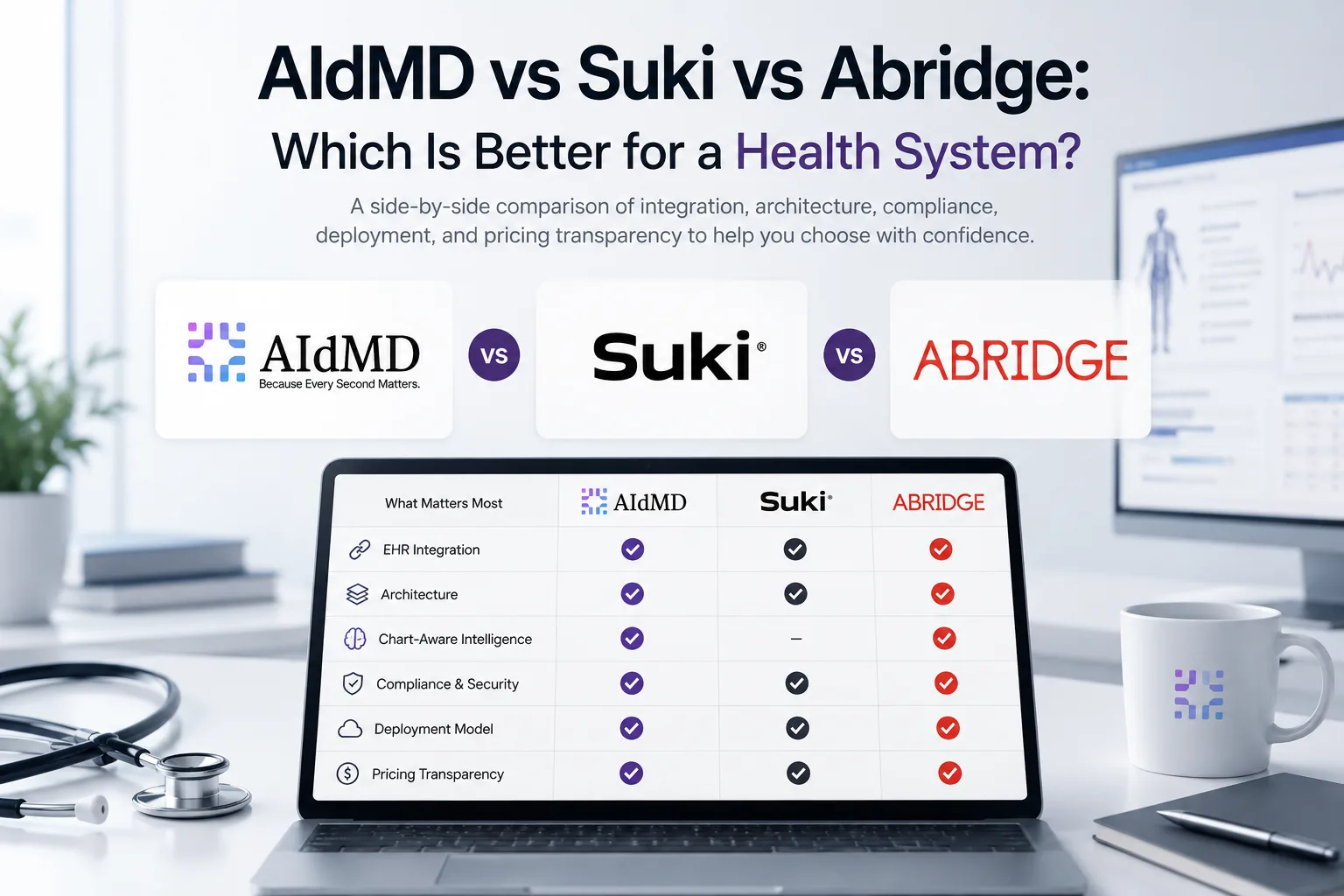
Suki and Abridge are ambient documentation platforms that start from the visit conversation; AIdMD is a clinical intelligence layer that starts from the chart. A side-by-side comparison of EHR integration, core architecture, compliance posture, deployment model, and pricing transparency, using each vendor's own published materials, plus which category a health system should fund first.
Voice-driven note capture is now the floor, not the ceiling. The harder question is what happens after the note is written: reconciling the encounter against labs and medications, surfacing the care gaps nobody raised, getting the coding right. Those are reasoning problems, not transcription problems.
A clinical intelligence layer connects to your existing EHR, reads the whole patient chart, and gives clinicians chart-aware summaries, risk and care-gap surfacing, and drafted next steps to approve — without replacing the EHR.
A working evaluation order for clinical documentation AI: start with BAA readiness and independent security attestation, then EHR write-back architecture and human-in-the-loop governance — and judge note quality last, on your own encounters.
Most enterprise clinical-AI platforms quote pricing through sales. AIdMD publishes per-provider pricing — $249, $299, and $349 across its three Insights tiers — so you can model cost before the first call.
A tour of the clinical workspace — how ambient scribing, chart-aware insights, and one-click clinical actions come together around a single patient visit.
What actually happens between 'the visit starts' and 'the note is signed'? A plain-language walkthrough of ambient clinical documentation — and where the clinician stays in control.
A practical due-diligence checklist for practices and health systems comparing AI documentation tools — covering compliance, data handling, integration, clinician control, and measurable outcomes.
Our platform is now generally available. Use AIdMD as your EHR, connect it to the EHR you already have, or start with standalone clinician tools — schedule a demo to claim your practice's free trial.